The wild does not have words.
– Tomas Tranströmer
Raven drops into the
arms of the old growth birch.
The trunk’s eyes gape, unblinking at the
neat crease of white horizon.
Sleekit-winged she perches
mutters a warning in some tongue
too old for memory.
The fur at the nape of my neck rises.
Weighted by her last feeding—
muscle memory and bone, fur and gore—
sky pulling her from the tree’s axis
a black iridescence praising sky
a velvet unfurling. Lifting.
Wings wide, she wheels off,
a passerine ink-stain
in the milk-pool of sky.
She will return. This is her wood.
Some comprehension that must
never be spoken settles in my gut.
Helplessness and Appetite
There was an embrace in death.
– Virginia Woolf, Mrs. Dalloway
Under a blank canvas sky becoming twilight, we walked to Lake Menomin. My fifth winter in an intimate courtship with this place. Out on the thin newborn ice, a Canada goose struggles to free an iced-in leg. We watch. Every few minutes, the goose presses dark wings into the translucent crust.
The only thing of color, one bright orange webbed foot, pushes against the cold surface. Ki’s[i] elegant neck lengthens, straining for release. Seeking liberation.
Then ki rests. This cycle of straining and rest continues.
We stand witness to this dilemma. Powerless from the shore, a half hour passes. Our breath rises to halo the waning moon, and we make for home.
We knock on the neighbor’s door, waking him from a lazy Sunday nap, “Is there someone we can contact? Can anything be done?” He says, “That goose is cooked unless the ice breaks up,” giving a wry, sleepy smile.
The next morning, I walk down to the lake’s edge with binoculars, hopeful in the light spit of mizzle that I won’t need them. Hopeful that the wind broke up the ice and ki has flown free.
Just imagining that goose in flight somehow frees me a bit from my own helplessness, just for a moment. Lyme and the endless months of antibiotics are eating me alive.
I hear the crows first as I come to the edge of the partially frozen lake. Then, I spot the eagle. Through binoculars, the only things of color are the sun-yellow beak of eagle and the rust-red lump of goose.
Heavy in the heart, yet transfixed, I watch eagle pull strands of this meat from between their talons. From the shore, frozen to the core, a half hour passes.
Impatient crows wait. Once fulfilled, eagle lifts shroud-black wings wide, and with a power and grace that defies me (that Lyme has denied me), ki rises into the gray and away.
Communion of Subjects
Honoring the losses of Alberta’s Fort McMurray wildfire.[ii]
10,000 spirits wrapped in summer clouds,
ushered by the northwest wind
came softly after such brutal raging.
After the thousand-mile journey dusted in stars.
Drifting in through the night-washed window.
An incense of lost and found,
a three a.m. waking while the world around slept.
For days this veil of ghosts draped over maples,
wrapped round lampposts occluding even the sun.
The mighty remains of jack pine, spruce.
Tracts of needle and thread grass,
eaks and bones, all ash.
Burnt offerings in my lungs – both foreign and known—
consumed, consummate, a sorrow, a loss.
The sublimation of a living world,
now falling ash—effortless as snow over the taiga,
dispersed by wide wings of Saskatoon swans,
digested by frog spawn dining in
Lake Manitoba and compost for the
lady slipper’s threaded roots.
Who says there isn’t enchantment in ashes.
Where is the story behind God?
[i] In her book, Braiding Sweetgrass Robin Wall Kimmerer recommends, instead of using the word, “it” to refer to non-human entities, to use the singular pronoun “ki,” from an Anishinaabe word for “beings of the living Earth.” The plural pronoun is “kin.”
[ii] On May 1, 2016, a wildfire began southwest of Fort McMurray, Alberta, Canada. The fire swept through the region, mostly wilderness, spreading across approximately 1,500,000 acres of land before it was declared to be under control on July 5, 2016. It was the largest wildfire evacuation in Alberta’s history, forcing 88,000 people from their homes. It continued to smolder and was fully extinguished on August 2, 2017. It is suspected to have been caused by humans in a remote area ten miles from Fort McMurray.
Notes:
Throughout my life I have always identified with the non-human world and often have felt quite alone in that experience. In my late 40s and through my 50s a string of personal losses, chronic illness, along with the undeniable losses through Climate Crisis opened me into unprecedented grief and a deeper intimacy and lasting unified sensorial connection with the more-than-human world. These pieces were written during that extraordinary time, and also coinciding with a move from an off-grid cabin in rural Northern Wisconsin to a small city further south.
About the Author
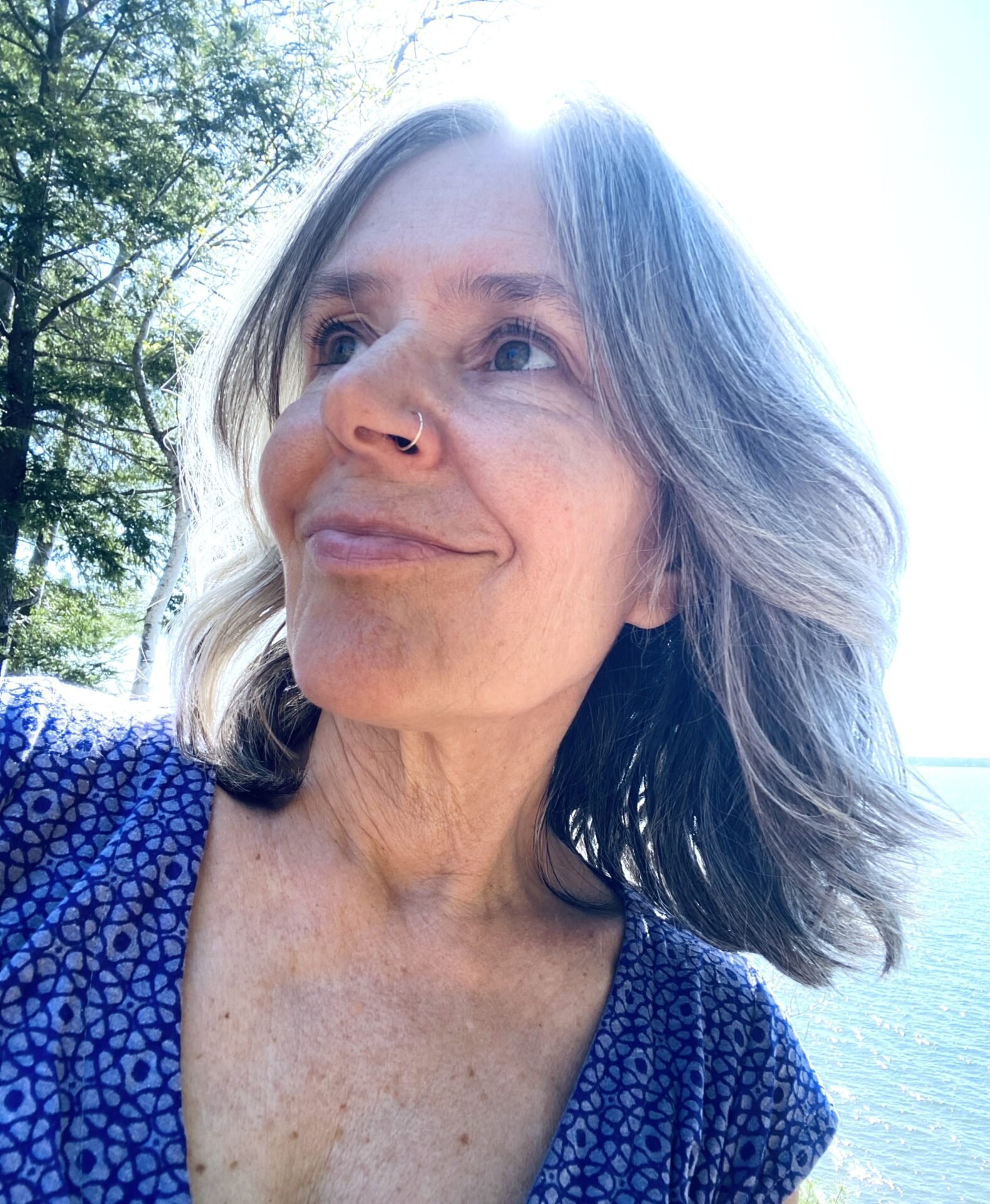
Tracy Chipman (she/they) is a neuro-spicy daughter of northern forests and Great Lakes. They are a mentor, educator, and language & healing artist exploring spoken and written language through solo & collective engagement, and body-based, trauma-aware practices inviting folx into sensorial aliveness & deeper connections with life. She lives at the edge of an inland sea in northern Wisconsin on the traditional territories of the Ojibwe peoples with her partner & two spoiled kitties. Currently their work is in discovery with cyclicity, women’s voices and power with (vs power over) systems. In March 2023 Tracy published her first book, Borealis Mundi – Resting in Place, Loss & Grace. More at www.tracychipman.net
Return to top
