In what is now a Dark Matter tradition, contributors to this issue convened on Zoom to discuss each other’s work. What follows is a highly edited version of our conversation.
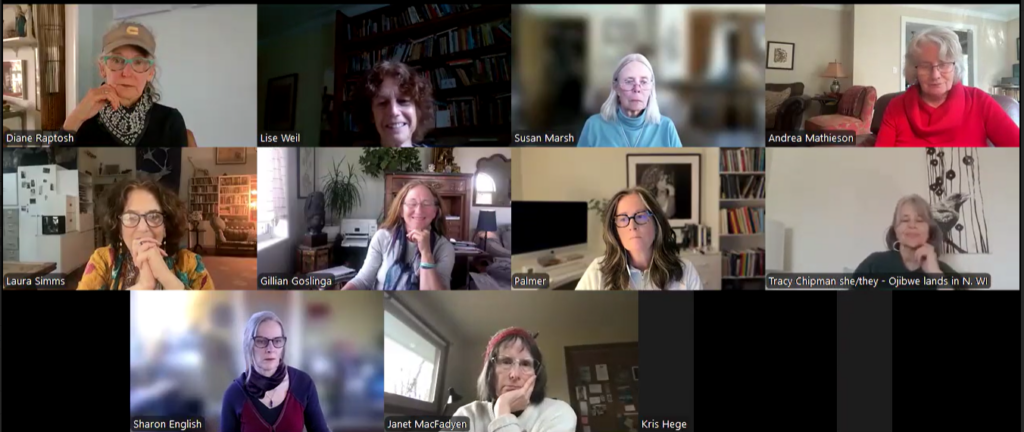
Lise: I’m struck by the fact that there is so much darkness in this issue, though the theme is intimacy. For example:
“I began kneeling because something in me had gone dim…” (Elena Rotzokou, Understory)
“Each morning I awaken, as do we all, to find new sinkholes of depravity and catastrophe expanding around me.” (Perdita Finn, To Bear Witness—and Why We Must)
“The wars have not ended. And more have begun.
And there is your shadow before I meet your eyes”…. (Margo Berdeshevsky, Shadow)
“Do not say – in the Nacht – that darkness is empty.’” (Jaspreet Mann, Do Not Say—in the Nacht)
“Be with me in creation’s dark womb…. Our work begins in darkness.” (Message from Gaia, Andrea Mathieson, A Great Organizing Tenderness)
In all of these pieces, the darkness gives rise to…tenderness. In Andrea’s case, in fact, she was given an instruction to “go deeper” and told, “This is where a Great Organizing Tenderness lives.”
In Understory, this is also Elena’s experience: “…beneath this thin layer of managed ground/the threads hold…I press my palms down… I cannot tell/whether I am touching/or being touched.”
In Jaspreet’s poem: “Why the smoke? Why the numbers pressed into skin? Silence answered first. Then a whisper, almost ashamed of its tenderness. Ani imcha. I am with you.”
“How could any one person hold so much horror in their heart?” Perdita asks. “Only by knowing that we do not hold any of this on our own… Only knowing that the dead hold us.”
And at the end of Margo’s poem the speaker declares: “Wrap me/I become all the not-dying wings. A not torn-winged girl.”
[–ed. “A Great Organizing Tenderness.” Once this phrase was articulated, we saw it everywhere in this issue. And we began to feel as if it were working us all as we spoke and listened.]
Tracy: “To see with the eyes of the dead is to see the long story.” There’s such comfort in that. Intimacy with the ancestral realm.
Gillian: Also the way that leads us out of catastrophe. The ancestors are there in my piece about my cats dying too.
Lise: In Kasey Jued’s Ocean, Field, she calls on the ancestors of a piece of land she knows and loves and whose future she fears for. They reply: “…there is an ocean beneath the ground, a vastness (you) can’t see… a forest of roots beneath the soil, touching and touching and touching…”
Anne: Martha Hagerman writes of touch as her path back to intimacy in The Roots of Intimacy: “One afternoon, I placed my hand against the bark of a camelthorn tree near the Orange River. Its surface was rough, scarred by years of wind and sun. Yet beneath that roughness was life…”
Diane: There is so much tenderness in Debbra’s poem Crab-Apples, which seems to be crying out for touch. The unloved children beside their unloving mother on the old mattress under the moon and the stars.
Laura: I had to read that poem out loud… the words were so beautiful.
Tracy: And Susan’s breathing poems. Breathing with Bramble made me cry.
Gillian: Laura in your piece The Eyes of the Lion there’s a great organizing tenderness in the rejected Roma children loving the unloved, abandoned animals in the zoo.
It’s that same tenderness that got me to walk alongside my cats and their deaths. It’s a place in the field and in ourselves and it just lifts you and it obligates you to care in the most desperate circumstances or desolate places. It’s connection, it’s both touching and bearing witness.
Susan: And it’s not just observation… it’s being with.
Sharon: Yes. And in these pieces there’s no offering of solutions or agendas, there are no positions, it’s just deep-down showing of relationship…the authenticity of being with. That’s what I find so moving….
Andrea: I really appreciated the notes for these poems. They brought on a deepening. To read about your husband and your cat on the bed in Night Music, Susan, and then to find out in the notes both had died. Whew. In others’ notes too I felt I was meeting the person behind the poem. And I loved this from Debbra’s notes: “Sometimes we need to get really small.”
Laura: I would like to add a note to my piece. I woke up thinking about the first line with the Roma woman asking me if it was helpful to tell stories in winter when it was freezing indoors because her husband had taken a piece of wood from the ceiling to make a fire. I was thinking if she asked me now I would say – of course when the snow falls through the holes in the roof you can tell stories!
Gillian: In Jaspreet’s poem she writes “Intimacy is not always warmth; sometimes it is the refusal to let go while burning.” I think that’s the greatest act of witnessing and I feel the lion in your piece does that.
Lise: So many of the writers in this issue do that. I think of Tracy staying with those ashes—or the Canada goose she witnesses in Helplessness and Appetite stuck in the ice and eventually being eaten by the eagle.
Andrea: Yes, and Keats in Wild Rose Hot Springs: “…Aren’t we all secretly in love/ with the ones who gnaw at us? To taste the bitter/ milk of our leaves and still return for seconds?”
Laura: In Mary George’s Where are the Spirits of the Salmon? she writes there was a time when “the earth was thin” and “the animals and humans could transform into one other.” I just sank right down to the time before we were separate.
Lise: And that’s echoed in so many other pieces. Keats’ Beaver Creek begins: “This is the name for the million skins/we undressed to cover our nakedness.”
Gillian: In Diane’s Of Wedlock the poet divorces herself only to find herself connected to the life all around her.
Lise: In Debbra’s In the 7th month of Ongoing House Repairs the wife says “Please go for a walk” and the poet does and there on the trail and at the riverbank she finds herself in everything she sees…
Diane: That’s where we get guidance! When we go out into nature…
Anne: And not only are we transformed when we go out, but the nonhuman world is also transforming itself and perceiving in so many of these pieces: for example, in Jaspreet’s poem “Serpentine tunnels remember. Granite remembers the ashen haze.”
Lise: And in Tracy’s Communion of Subjects the ashes from Alberta’s Fort McMurray wildfire remember their origin in jack pine, spruce, beaks and bones…. “Burnt offerings in my lungs….”
Diane: In Janet’s The moon is lovely, we must not say so: “Whenever you look at a tree apparently/ your eyes suck in specks of it and likewise it takes you in…/How else to explain that fullness/and fatigue while walking away/ from an encounter?”
Gillian: And in the next stanza “the eyes/say yes, even if we refuse…” I love that. Even if we refuse to see, “the moon…/leaves slivers in our eyes…”
Diane: Yeah. Human agency is overruled.
Tracy: As I move through these pieces I’m amazed by the threads between them… whether it’s how it was curated or part of the magic, how our pieces are entangled with each other. It feels like a healing from one piece to another.
Andrea: Yes, it’s the weave between us that so excites me.
Susan: The other thing we all seem to share: the pieces almost all hint at devastation or dying but then there is this thought of resurrection or renewal…. In Adrienne Pilon’s poem Rehabilitation the boys break into the marine sanctuary and brutally attack a stingray and a shark. But then when gentle human visitors come later the rays move toward their hands in the water “as though they seek our touch….”
Sharon: Holly Phillips’ essay, What We Plant When We’re Broken, starts in total loss: the dream of a life on a farm with her family, connected to the natural world, all gone south. Phillips shows us how recovery can happen in a family garden or a scrappy urban backyard. How these become the medicine needed.
Gillian: At the end of Mary George’s piece the old man is asked—will the salmon swim in contaminated waters? He answers: salmon are clean, they can smell. It’s like that with this journal– there’s a level of cleanliness away from those toxic structures that allows us like the salmon to smell what’s authentic and not authentic and it allows these gems of really profound original wisdom to come forward.
Laura: I felt when I was reading that I was awash in words and that we were capturing what was ineffable. The voices in the poems speak to one another like roots. Like the bottoms of words before they’re written down…
Tracy: And the space between the words holds a frequency or energy that is us and more than us.
Andrea: This feels like a threshold issue and I can’t think of a darker time for these voices to come out. In my piece I quote these lines I received from Gaia in 2004:
Next to the broken and the dying,
There is always something whole.
As I write there: “It’s a reminder for each of us to look beyond the turmoil, and it is also an invitation to sink six feet under, into that Great Organizing Tenderness.”
Return to top
