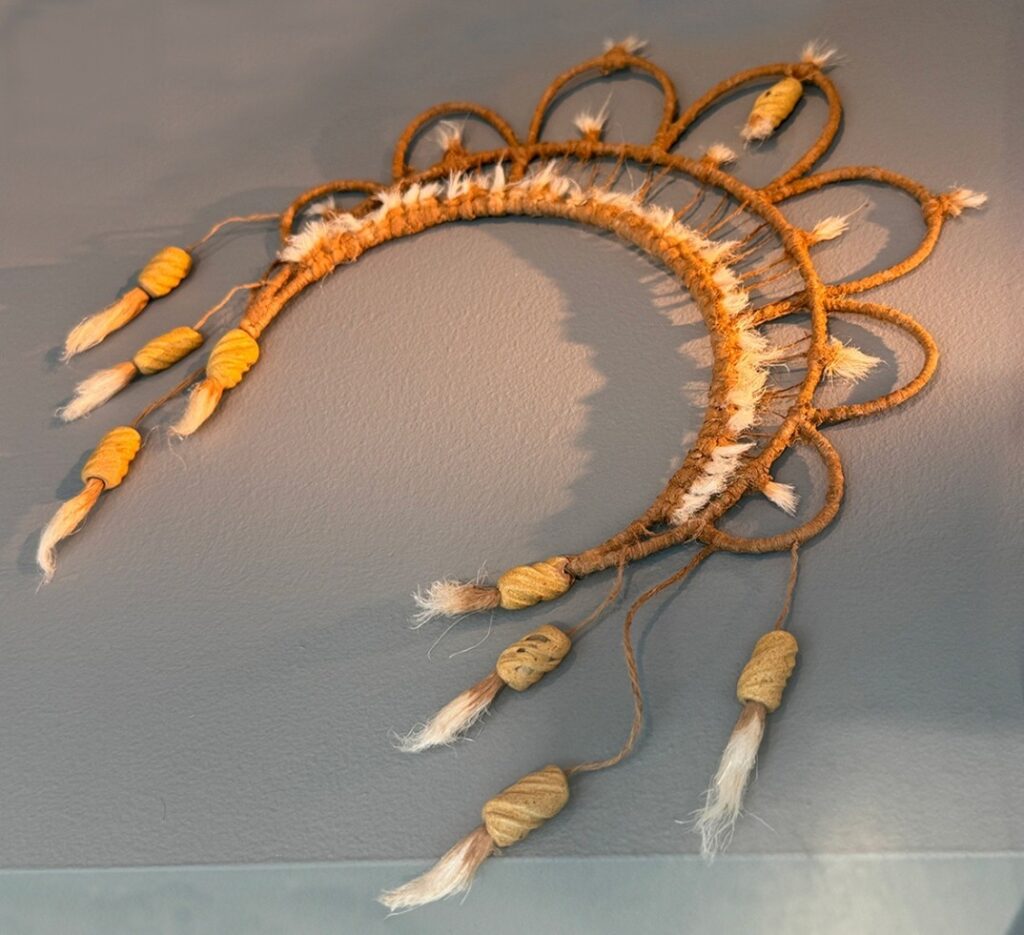
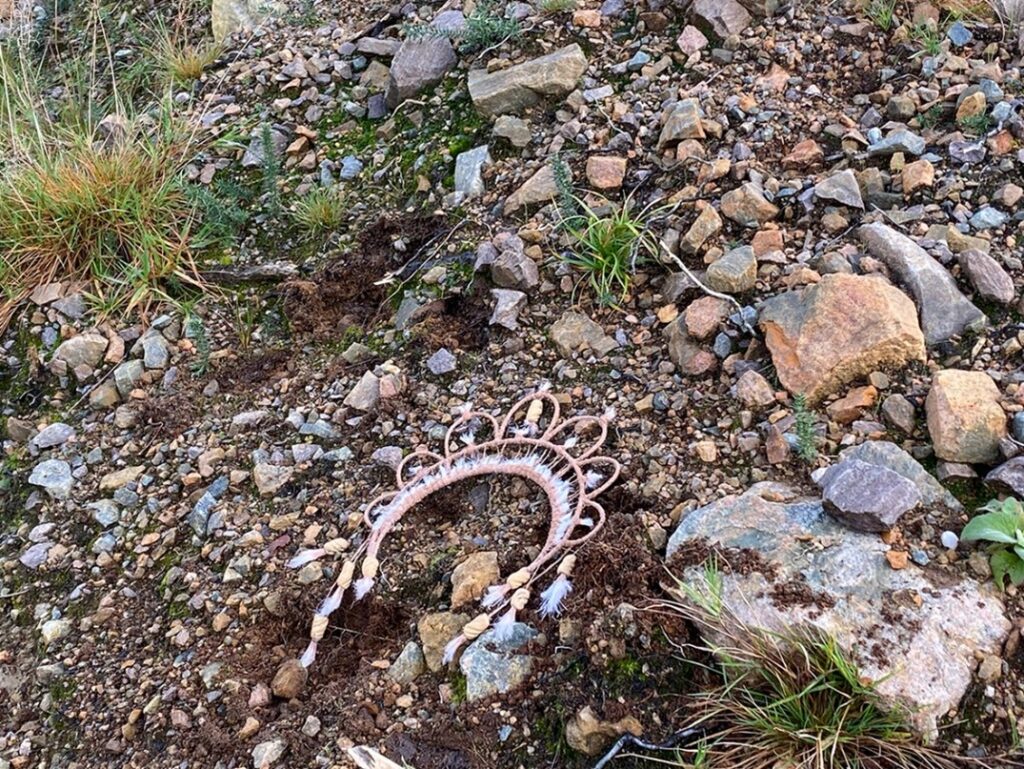
Images: Digging A Cathedral. ©Armadillo & Hamilton, I. (2024). Steel, Textile, Hand-Dug Clay & Handmade Ceramic Beads.
Notes
Throughout this life, I have been able to communicate with Majority-animals[i], plants and landscapes using thoughts and feelings. Opening channels between my inner landscape and that of another being is a compassionate, intimate act based on trust. People the world over use this innate, embodied, telepathic method, which academics refer to as ‘Intuitive Interspecies Communication,’ or IIC (Barrett et al., 2021)[ii]. It is a core factor of my current PhD research.
In this intuitive interspecies communication, an Armadillo projected images, sound and sensations onto mine so that I might feel and experience what they feel and experience when digging a hole. Or what I believed would be a hole but was in fact a carefully considered, structurally calculated burrow. Drawing me into the act, this Armadillo revealed their engineering knowledge, explaining how the arch of the burrow is as important as the arches of a cathedral or palace. Below is a snippet of the transcript capturing the images and audible information I was experiencing.
Inga Hamilton:“[Armadillo wants to] talk about the engineering of burrowing. People think that they just dig a patch [but] they need to understand the soil weight, the depth that they’re digging up because they don’t want it to collapse above their heads and bury them.
[The Armadillo is] showing it’s creating a cathedral, a palace underground. That we go into things like the Sagrada Familia and look up and think “Wow!”. Well, they can do the same inside. They can create these caverns for them that are sanctuaries. They are havens. They are safe. They are warm.” Armadillo 5th December 2023
My challenge is to create a piece of jewellery that captures this communication and instigates human debate. As an art-jeweller, I work with intimate objects, filled with significance and laid on the body. Choosing a halo adornment to reference the religious aspect of the Armadillo’s communication, I designed arches to echo those of the Sagrada Familia minor basilica – echoing the calculated structural strength present above the Armadillo’s head as they dig. Painted with earth, the small white tufts of the halo represent the Armadillo’s bristles.
Whilst I usually perform in the art-jewellery I make, I have yet to do so in this halo. It awaits a reverential setting. An earthy setting. A tightly-packed and intimate setting.
[i] During an IIC interview with a Whale, they helped me to reframe my thinking around how things are made.The Whale showed me an enormous Venn diagram of all the animals on the planet gathered together. In it, there was a tiny – a miniscule – subset of those of us animals with hands. They explained that the majority of animals don’t have hands and that intead of “handmade” I should find a craft term that was non-speciesist and ableist. I went on to define the making practice as ‘decisionmade’. It was during this exchange that we birthed the term ‘Majority-animals’, which I attribute mainly to Whale, for I would not have this shared thought without them projecting it. I now use the term Majority-animals rather than nonhuman-animals. Whale’s diagram demonstrated that the majority of individual animals alive are not human and I believe they have a right to be recognised without human reference.
At the 2025 MEAM conference (Multispecies Ethnography and Artistic Methods Conference) held by the Australian National University, the term Majority-animals expanded and ‘Majority-beings’ was coined by Simone G. de Boer to reference every type of being that isn’t human – from landscape, to plant, fungi, to weather. These terms are beginning to gain traction, with them now being used in universities and IIC groups around the world.
[ii]Barrett, M.J. et al. (2021) ‘Speaking With Other Animals Through Intuitive Interspecies Communication: towards cognitive and interspecies justice’, in A. Hovorka, S. McCubbin, and L. Van Patter (eds) A Research Agenda for Animal Geographies. Cheltenham, Glos & Northampton MA: Edward Elgar Publishing, pp. 149–166.
About the Author
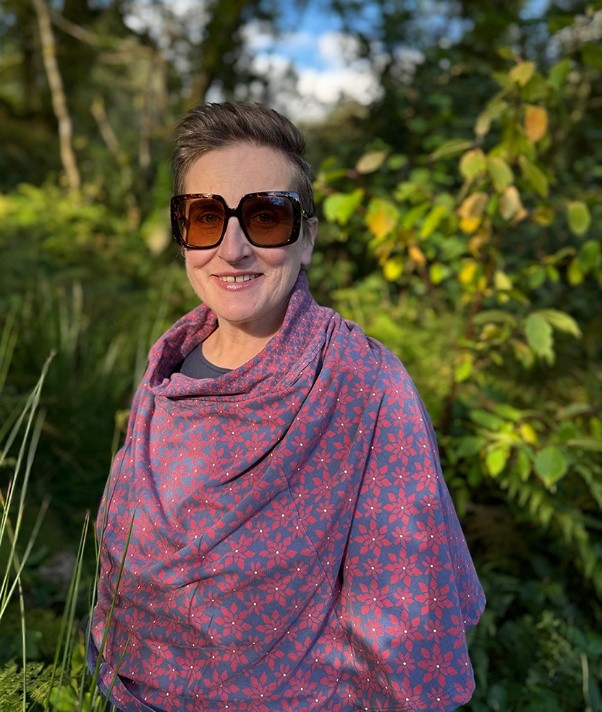
Inga Hamilton is an Autistic sculptor, activist and art-jeweller. She is instrumental in a worldwide network of academics re-normalising IIC and reconnecting humans with our fellow planetary kin. As part of her PhD research, she has developed a creative IIC methodology that she uses to co-create art jewellery with Majority-animals. The piece you see here is just one of the results of these communications about the things that Majority-animals make. Hamilton’s art-jewellery explores concepts of animal artisanship, including crediting all those involved in a creative act. By blending the spaces between species, she prompts humans to realise how similar we are to our multibeing kin.
Hamilton’s artwork shows in galleries worldwide. She has spun yarns for the late Alexander McQueen at Gucci, represented Irish craft in the American Irish Historical Society in New York, USA, and won the Association of Contemporary Jewellers Graduate Award. Her career includes creating art content and writing for children’s publications as well as international residencies and exhibitions. Her PhD is with the University of Sunderland, UK.
Inga lives in Fermanagh in Ireland/Northern Ireland. www.ingahamilton.com
Return to top
