They walk into infinite mists,
forests of light, branches cutting
the distant ridges, the air itself
on fire.
By dusk, the ground is ablaze, the sap
bleeding out. The birches are already
ghosts, their pale bodies peeling
against the horizon in a burst of light.
Others stand leafless in water
leaning unstably, waiting
until the mists finally part, and she
is there, the ancient and solitary one,
raising her massive limbs in invocation,
a hundred branches forking into lightning,
a thousand fingers dipping into thunderheads,
drawing the torrent down.
Notes:
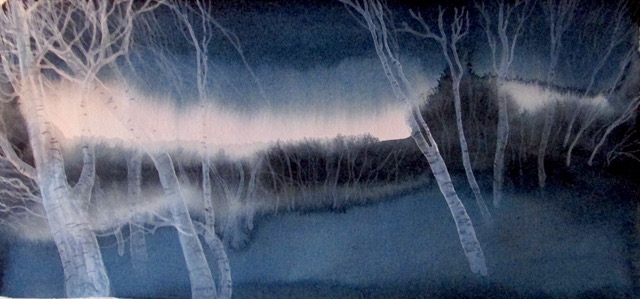
This poem is partly ekphrastic, in that I drew its inspiration from the works of Valerie Claff, a watercolorist whose work I love (https://valerieclaff.com/home.html). Now that the poem is complete, I think/hope it stands on its own.
If a neutrino moves—physicists say—
another neutrino meters away
(miles and miles in neutrino land)
will be affected, will wave hello
though no known ties exist between them.
Or if it’s not the neutrino, it’s his nephew,
the tau, or Aunt Electron—
in any case family ties are strong
among sub-atomic particles. And whenever
you look at a tree apparently
your eyes suck in specks of it
and likewise it takes you in
in its treelike way—Scientists have yet
to prove this last corollary,
but they should do so soon—
How else to explain that fullness
and fatigue while walking away
from an encounter? But we,
poor poets, are afraid to open our eyes
lest the “flowing wholeness”
make fools of us, lest the moon
rising from its nest of pines
reduce us to indiscriminate cries.
What is there that we cannot love
or that cannot love us? Loveliness
becomes an act of submission— the eyes
say yes, even if we refuse,
they seize and digest this thing
hanging in the skies (arc-lamp, clove
of garlic, thumbnail, pearl)
while the moon, old traveler,
leaves slivers in our eyes
glowing long afterwards under the skin:
the alter ego, the dark side.
Notes:
I majored in science, and have always had a love for the complete strangeness of the universe when looked at in sub-atomic detail. And so when I read the physicist David Bohm’s theory of the universe being connected by a flowing wholeness, I was stunned. His corollary led to the idea that the act of seeing something actually requires a physical or wave exchange between the eye and the object, which makes us intimate with everything in our line of sight. I had to write this poem.
Paintings by Valerie Claff
About the Author
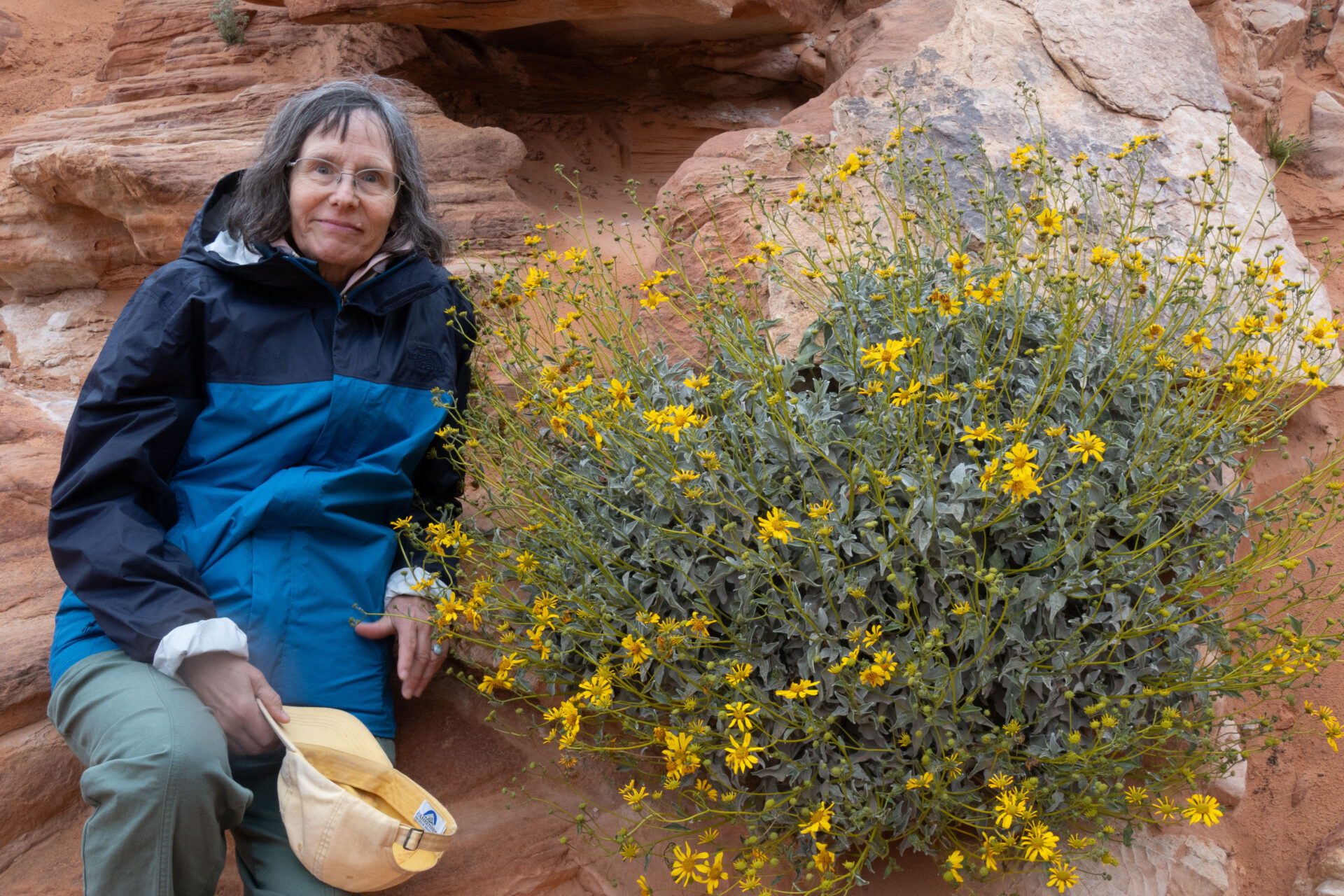
Janet MacFadyen is the author of four full-length collections—most recently Love Letters to the Wild (Dos Madres) and State of Grass (Salmon Poetry)—and four chapbooks. Honors include a Massachusetts Cultural Council grant, a Cill Rialaig residency, and a 7-month Provincetown Fine Arts Work Center fellowship. Her poems appear widely, most recently or forthcoming in SWIMM, Slant, Osiris, and The Tiny Seed. She is the managing editor of Slate Roof Press, a collaboratively-run poetry chapbook publisher; in another life she was a rock hound and worked for a meteorological instrument manufacturer.
Valerie Claff is an artist living in a hemlock forest who seeks the solace of wild places. Growing up in a house full of Chinese and Japanese artwork, she was highly influenced by the infinite spaces and mists in brush painting, and the use of minimal detail to evoke the spirit of place. Forests, hills and open spaces are inspiration for her landscapes, painted from memory, in a non-traditional watercolor style. Utilizing a wet on wet technique, she manipulates the bleeding paint to suggest fog, mist, reflections, light and atmosphere. Trees are important features in her work – forests with mysterious light and mists, stands of trees lining the edges of ponds, and solitary trees in open spaces, their linear branches creating contrasts to distant ridges and atmosphere. Her paintings seek to convey her relationship to the wild as a place of sanctuary and mystery and to capture the essence of natural places in different light situations and seasons. The rural foothills of the Berkshires, and the forest surrounding her home are the main inspirations for her work.
Return to top
