I learned so much from these pieces. Who knew giraffes hum at night?
Melissa Kwasny
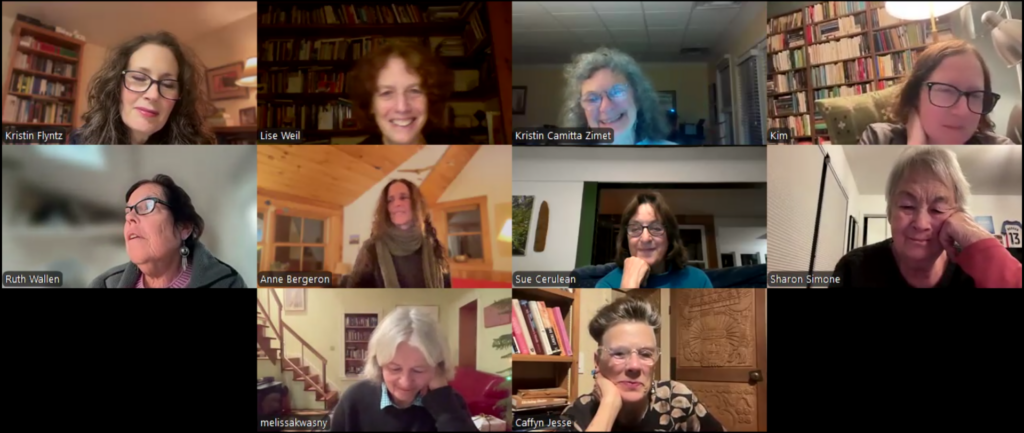
In what is now a Dark Matter tradition, contributors to this issue convened on Zoom to discuss each others’ work. What follows is a highly edited version of our conversation.
Kristin: I was astonished at how closely bonded we appear to be. Every one of you I felt might be my neighbor or dear friend. That’s never happened before in a journal in which I’ve been published.
Lise: Well the issue does open and close with love. We’ve never been mushy like that before. But in The Shape of Love Caffyn writes: “There is a deep intelligence in systems that pulse, align, and become real through resonance. Love is a name we can give to this intelligence.” So maybe not so mushy after all.
Sharon: I have gone mostly blind in the last three years and am trying to adapt. I read every word of every one of your pieces over a period of three days and it was so healing. I was completely blown away by the hydrologist (ed. note: Natasha Liora’s Everything Belongs to the River is the story of a hydrologist who’s been assigned to investigate a river that flows backwards). I was overtaken by the shredding of the definitions we put around everything. It took apart iron framing that shaped my consciousness as a scientist.
Melissa: “The irony of bringing scientific instruments to measure something that exists outside scientific law.” It’s like a Dark Matter motto… I noticed she uses a lot of “as if” and “like”– so many similes to get us close to what she’s describing… I like that.
Kristin: I live and work among people who have an enormous love of nature and they’re all scientists… but none of them are seeing what I’m seeing and if I told them it would all be an “as if” to them. At best. I felt such comfort in this issue because there was no “as-if ing” necessary.
Sue: I loved that piece also. At first I didn’t realize it was fiction. To say “my specialty is dying rivers.” That’s just where we’re all at. Or: “His eyes held the accumulated weight of watching beautiful things disappear.” Yes… don’t we all…
Ruth: Yes… and the way she imagines the river as “concentrated grief” reminds me of Laura Simms’ essay on myth—when she talks about mythic listening: “Mythic listening is the most ancient technology of our world, the most intimate relationship with ourselves, with the visible and the invisible realms, the impossible and the possible.”
Many pieces invoked that kind of mythic listening. Sue I really felt that in your piece —when your three-year-old grandson is telling this dream and it’s what you’d just experienced with the blue heron(Great Blue Heron: Six True Things). And at the end when you pray “What can I do to protect you? Help me know how.” That kind of mythic knowing also comes from a real commitment to presence….You’ve been with those birds for years and years and there’s an integrity and authority that comes through .
Lise: And how long have you been sitting with the oaks Ruth?
Ruth: For about fifteen years…
Caffyn: It felt like we were all pointing to the same thing: this alternate technology that’s about listening at a molecular and cellular level… It seemed to me most of the writing was about sinking into that alternate world where intimacy just is…. The piece that really did it to me was Kristin’s How To… “Or oak, any of the standing people:/you keep sewing secret threads/ among species, lovers touching/under the table.” In that poem it just rises up and “this is how to.” Perfect instruction manual.
Sharon: Colonized consciousness is what separates us all and the changing of it is a thing this journal opens its arms to. It’s what’s happening in all these pieces including my own.
Anne: Sharon, I loved to picture you straddling the continental Divide (The Great Divide). You write: “It was a feeling-knowingmoment, a healing return to a great belongingthat I knew nothing about cognitively, but felt deeply in my limbs, ribcage and body-center.” I also love to think of you having tectonic plates..
Lise: Sydney Kale, who couldn’t be with us tonight, in notes she sent said this: “In much of the writing here, I encountered intimacy as a vulnerability to touch and to surrender to our edges, where we touch the world and the world touches back.”
Caffyn: Yes… the eros of Anne’s poem, in which the world reaches back.. an intimacy that’s unique to each person… or tree. The sweet sap, the furrowed bark.
Sue: “I rest my cheek on your husk. I swear you press back.” Isn’t that what we all want? I love that in Anne’s piece.
Lise: “I slow until the forest recognizes me” in Kris Hege’s The Distance Between Breath and Bark. There is more intimacy between humans and trees in this issue than between humans.
Anne: In Marion Dorval’s Dans Quel Repli Caches-Tu? the languages coming together is its own form of intimacy. There was a layered human intimacy in the translation that brought that piece to life.
Ruth: The juxtaposition of two languages is poignant because it gets at the challenge of how to use human language to speak with trees… It’s also an invitation to each one of us about how we make those relationships.
Lise: Sydney (Intimacy as Origins, as Told by Tea Drinking) writes of her MA research on plants: “My first research question was, ‘What is the love language of plants?’ which I had previously believed not only unanswerable but unaskable…The response of the plants was seemingly simple and straightforward: ‘If you want to know the love languages of plants, you need to fall in love with a plant.’”
Kim: I loved Sydney’s piece. To think of intimacy in terms of ingesting herbal medicines— actually taking something into your body. The way sound enters you.
Lise: In Confluence, sophie writes of the lichen she has just seen covering the branches of a spruce: “I do not know their names, their histories or collaborations or their intimacies…Even knowing the names we have given them, I will not know them as they know themselves.”
Anne: I love this intimate attention in that piece to something so easy to overlook. You have to bend down and touch it and feel its spores…
Ruth: I loved the diagram… because lichens are so complicated, so layered.
Kristin: Lichen itself is a symbiosis so it was perfectly appropriate
Kim: We wanted to model visually the way the lichen converses with the world around it and transcribes its environment. They’re like a little archive of the larger environment…
Melissa: Firsthand observation is one thing science and poetry have in common. I admire people (like Sue in Great Blue Heron) who know individual birds, not species… That’s forming a relationship. I always think science is trying to listen to the world. Poetic thinking expands its reach, and yours shows it, Kim, and so does Kristin’s, so does Sue’s. And I love Sydney’s…such a different way of knowing and observation. Maybe in the way that surrealism added dream, chance, and the unconscious to objective reality, poetry added to science can create a super-science.
And I want to thank you, Ruth, for the overview of Joanna Macy’s work. I just loved the tribute to her. Thinking of what Kristin wrote in the notes to her poem—“We can’t grieve for what we don’t let ourselves see”—Joanna was all about that. Witnessing, and then bearing witness is difficult but …we’re all writers so that’s what we do and I don’t know what else to do.
At our request, Melissa reads What the Candle Flame Knows.
Ruth: How can we be intimate in these times when there’s so much loss and grief?… The candle is such a powerful image for that. How to stay present and work with light and dark and horror.
Return to top
