The following is both memory and vision: an attempt to articulate how intimacy reveals itself as the underlying shape of reality. I write from within the felt experience of love as more than emotion. Love is structure; love is the very field that molecules, rivers, flowers, animals, and humans inhabit together.
Through offering and receiving embodied love, I remember that generosity and delight are not inventions of human culture. They are the shape of all existence. In this sense, intimacy is ecological—it is the force that allows life to flourish, and gives us shapes that resist the violence of separation.
This vision is my response to the grief of species loss. Intimacy is also guidance: a way back into reciprocity with the Earth.
I’ve received messages of hate for most of my life. From people who barely know me. From strangers who’ve never met me. From lovers who want to leave me. People go out of their way to say I should not exist—that my queerness, my erotic practice, my sacred intimacies, my neurodivergence, my mistakes, or something I embody evokes their hate.
Strangely, many of these messages come dressed in the language of love. If only I weren’t queer. If I didn’t offer erotic touch. If I loved just them and no other. If I was different—or less different. If I didn’t make mistakes. Then I might deserve care. Then I could be welcome.
What parts of me need to harden or hide, just to stand in the stream of hate?
And yet—there’s another stream. One I’ve stood in just as long. A stream of love that quenches thirst, softens what is rigid, engorges what longs to rise, and whispers to the molecules of me:
Welcome. You get to exist. You get to become. Even the mistakes. Even the ache. Even the magnificence. Don’t wait. Feel the radical kindness. Drink in the erotic generosity. Accept the unconditional goodwill.1
This is the love I try imperfectly to practice. And I am loved into life this way, by rivers, flowers, and companion animals—and by human friends. I offer love in return, as best I can—not because I always feel kind, generous, or welcoming, but because I am a commitment to embodied love. I know what love can do when it lands. What it evokes. What it makes possible. And so I don’t wait to deserve love, or require someone to be worthy of love, before offering or receiving love. The guiding imperative is simple: be love.
I’ve been paid, with joy and integrity, to be love. Sacred intimacy, sex work, therapeutic exchange, teaching—these can all be sites of love’s arrival, when rooted in presence and empowered choice. Love disappears when we don’t have choices. When care must prove its worth through bureaucratic legitimacy. When teaching becomes credentialing. When economies flatten everything into extraction and compliance.
We can take every opportunity for love and twist it into domination and disavowal. Or we can step into another chance to embody love.
Embodied love lands in the meat of us. Cells ease and open; molecules settle—but we do not collapse. We feel vasodilation—physically, emotionally, spiritually. From settling and opening, we rise.
Love doesn’t ask for parts to be hidden—but it welcomes secrets. It doesn’t require sameness—nor exoticize difference. It welcomes our ordinariness and extraordinariness. It cherishes both our worthiness and our unworthiness. It makes space for the whole spectrum of response: Yes, No, Maybe, and Maybe- Not. Love can be disappointed—and disappointing—and still be love.
The embodied love I’ve found and tried to practice—the kind that lets bodies rest and beings rise—is not uniquely human. It’s a pattern the universe offers and embodies at every scale. Love is the resonant field that arises when singularities meet each other with radical kindness, erotic generosity, and unconditional goodwill.
Molecules embody this. They find one another by shape, charge, and field potential. Their alignment is precise. Their generosity is structural. They meet at the edges of their difference—and if the fit is right, they can form into something new. The field welcomes a new becoming, in which singularity feels joined and amplified at every level: quark, hadron, atom, small molecule, large molecule.
In biology, multicellular life depends on differentiation with communication. The miracle is specificity in relationship. Liver cells are not skin cells. Neurons are not muscle. They cooperate by doing different things well—and listening to each other.
Human love is also the capacity to amplify distinctiveness while contributing to the larger unity of a living field—responsive, charged, alive with possibility.
There is a deep intelligence in systems that pulse, align, and become real through resonance. Love is a name we can give to this intelligence, when we sense the precision of what meets us. When we become ourselves, ever-new in relationship. When we feel ourselves undeserving—and yet, belonging. When something we’ve longed to let rest, settles. And something we’ve longed to feel rise, engorges.
This is what love can be: physics, chemistry, biology.
Not reward and punishment—
but the way things are, and will always be.
About the Author
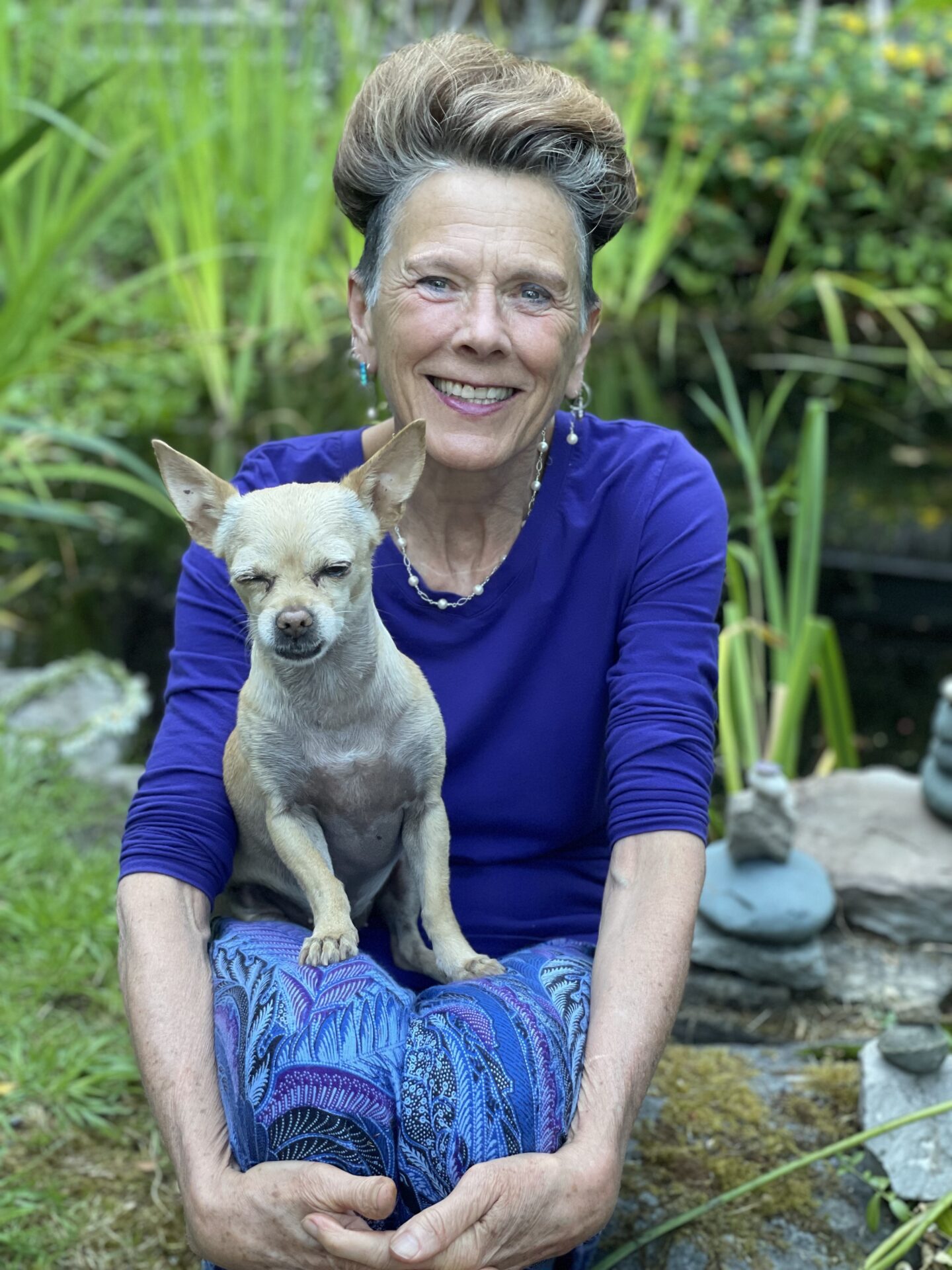
Caffyn Jesse is a longtime teacher of somatic sexual wellness, as well as a writer and a queer elder. They offer an online program on the art and science of Sacred Intimacy. Books include Love and Death in a Queer Universe, Science for Sexual Happiness and Elements of Intimacy. Caffyn lives on Salt Spring Island, where they walk by the sea, and talk with trees. See more on their website www.EcstaticBelonging.com
Return to top
