Healing is a drillhole
directed straight at one’s tectonic plates
Present time
Last night as I was falling asleep, I was given a great gift—an image that took me to an understanding of critical importance, one that I had not, before this experience, given any berth to.
In a flash of vision, I saw myself standing, feet firmly planted, atop the geologic crest of the Great Divide—an iconic 650-mile mountainous segment of the Continental Divide that passes through the heart of Colorado, separating the North American Continent into Pacific and Atlantic watersheds—a cleaving that is ultimately a result of a massive movement of Earth’s tectonic plates away from each other more than 300 million years ago. Before this, only one supercontinent existed and it was comprised of North America, South America, Africa, Europe, Asia, Australia and Antartica. It was called Pangea, meaning all lands.
Presented with this image of myself straddling the divide, I was transported…
I once spent a few days at the Great Divide on the Western slope-side in Colorado at Grand Lake (both a mountain town and a lake), an experience that remains permanently inscribed in my sinews all the way down to my own tectonic plates—the deepest region in me where, I believe, my life force resides.
I recognized in this a seed of what I call an inquiry from theedge.It arrived as two questions: Is there a Great Divide within me? Are my own tectonic plates part of or separate from the Earth’s tectonic plates—those massive slabs of rock deep beneath the planet’s land masses holding everything up?
***
I was very young, probably in second grade, when my family stayed at the Great Divide, a 400-feet-deep and 500-acres-wide freshwater lake fed by snowmelt from the high Rockies. Although I did not have any knowledge of the geologic nature or significance of it then, nor did my parents speak of this marvel in those days, I felt something there—a physical tugging mid-chest, a magnetic force pulling me in, taking me back, as if I had been stolen, ripped from home and now returned.
One early morning at Grand Lake, I woke up on the top bunk of Red Bird cabin while the rest of my family still slept. I wanted to get up and go outside but I knew not to do this alone without permission—it would have set off my father—so without leaving the top bunk, I slipped quietly out the screen door into the early mountain morning and headed straight for a giant grey boulder, higher than my head, standing out in front of our cabin.
Scaling this rock—really a small mountain to me—with nothing but my white rubber-bottomed Keds for gripping and my fingernails to provide a little balance, I summited, then took in the quiet—the lake, the mountains, and the vanilla aroma of Ponderosa pines filling the air and (then) my lungs. I did not take in the view from the little mountain I was sitting on top of; the view was of no interest to me because something far more encompassing had overtaken me. I belonged to everything and felt intimately one with the rock, the lake, the mountains, the Ponderosa pine aroma and the air. This oneness experience was more ecstatic and quiet than any view could ever be, or than I had words or concepts to describe even to myself, until now pausing to reflect. I had been folded back in and was an intimate part of a whole; we (rock, lake, mountains, pines, air, me)were one entity. It was a feeling-knowingmoment, a healing return to a great belongingthat I knew nothing about cognitively, but felt deeply in my limbs, ribcage and body-center.
These moments at the Great Divide took up residence in my tissues, muscles, nerves, organs and marrow and shaped the way I moved and lived in the world from then forward. I still would not know how intimately I belong to the Earth without having followed this vision—though my marrow never forgot what my body knew on that early morning when I summited the rock. A separation across all the years that followed was mended with this journey back to Grand Lake.
Near the beginning of Reckonings, my memoir-in-progress, I recount a vision of being summoned by an old, old woman spirit (I call her Bone Woman) to her cave at the top of a high desert mountain. For many years, this spirit has been instructing me in ways of mending what has been violently torn between the worlds of the living and the dead.
A decade ago, beneath a white moon full and high in a black sky, I followed Bone Woman up a mountainside to her cave for the first time. Near the summit, fierce wind currents picked up, making it difficult for me to continue ascending the mountain. Simultaneously, sounds of a symphony began to emanate from a cavern deep in my body—violins, cellos, flutes and piccolos. The sounds ebbed and flowed in synchrony with the wind currents until all that remained in and outside of me was music.
It would take a decade to comprehend what took place in me on that climb—until tonight before sleep when, in a vision, I saw myself standing atop the Great Divide. Two visions converged. Me atop the Divide before sleep in present time, and me at seven, summiting the grey rock at Grand Lake. It took a decade for me to understand the mysterious words I wrote in a journal chronicling my first journey up the mountain to Bone Woman: In the climb I became a song whistling moonlight and wind back into every lost river and canyon into which I was born—a woman to herself returned. This is the same knowing-feeling that I experienced at the Great Divide at seven—a return to a Great Belonging—one with everything I was originally born into, but fell out of knowingwith my rationalmind.
It has taken me so long to allow into my mind the reality that there is no separation between my life force and that of the planet’s—trained as I have been as a scientist to separate and catalogue everything until nothing of the Whole remains. Chemistry and biology degrees and hospital medical laboratory work that followed were one way this Divide took root then deepened, but not the only way. During sixteen years of Catholic education, matter was always described as lower or less than Spirit.
***
Our stay at Grand Lake was short. On the way out of Rocky Mountain National Park that shelters Grand Lake on three sides, we drove by a small white road sign that read Headwaters of the Colorado River. We stopped by the side of the road briefly but did not get out of the car. I saw only a small trickle of water burbling up through a clump of grasses. Glimpsing this embryonic form of the Colorado River out the car window generated in me an overpowering urge to one day follow this trickle until it swelled into the mighty Colorado.
This deep longing seeded itself in me those days we lived at the Great Divide and broadened to include all of the rivers our family visited in Colorado that are part of the Great Divide that I came to love growing up—Gunnison, Platte, Colorado, Arkansas, and Rio Grande. Every icy stream or still shallow in Colorado waters that I put my feet into thereafter generated a reflex. Instinctively I lifted my eyes upstream, like a prayer—petitioning to be fortunate enough, one day, to follow these waters first up to their source, and then downstream to their wide-bodied grandeur.
To become a song whistling moonlight and wind back into every lost river and canyon into which I was born—a woman to herself returned.
About the Author
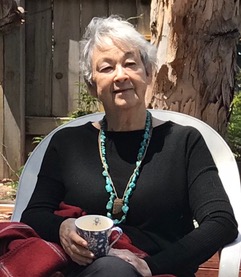
A scientist by education and training, Sharon spent more than thirty years as a chemist and biologist in major medical institutions in Detroit and Boston. Across the last decade, she has given herself over to healing (her own, others and the planet’s).
Ordinary sight left her during the last three years. In its place she relies now on another kind of sight—vision, a way of seeing and knowing she learned growing up at the foot of Tavá Kaavì (Sun Mountain) in the Colorado Springs region. This 14,115-foot mountain was named by the Ute People who considered themselves to have lived in proximity to Tavá Kaavì since the beginning of time.
During the Colorado Gold Rush (1858/59) the Ute People were forcibly removed from their ancestral lands and Tavá Kaavì to make room for gold thirsty settlers who overtook the Sun Mountain region. Tavá Kaavì was “re-named” Pike’s Peak for an explorer in 1890.
I did not know of this violence or of this People’s removal when, as a girl growing up at the foot of this mountain, daily I oriented my face, body and spirit, like a prayer, to this sacred mountain. I only knew the settle’s name for Tavá Kaavì—Pikes Peak.
Is it possible now to offer here, as this writer’s solitary credential, that I now know, speak ofand mourn this tragedy, this decimation of a mountain and a People?
It has taken seven decades for me to learn the true name of the mountain that held me, shaped me, inspired me growing up.
Sorrow has taken its rightful place in my heart over this.
Return to top
