I.
When I first started studying plants, I never could’ve imagined how we would come to inhabit each other. My first research question was, “What is the love language of plants?”, which I had previously believed not only unanswerable but unaskable. This question was followed by “How do we go about answering such questions?” and “What are the implications for asking such questions within academic and scientific contexts?” The response of the plants was seemingly simple and straightforward: “If you want to know the love languages of plants, you need to fall in love with a plant.”
These questions first emerged during the writing of a Master’s thesis at Schumacher College, a paper written in collaboration with a plant and including a declaration of ethical responsibility to plants, Indigenous knowers, and to myself. I adopted the same practice for my Ph.D. dissertation, currently in progress. Within both declarations, the need to drink tea with myself and the promise to do so are made explicit. Tea drinking has become an unexpected and integral part of my academic studies, a way of knowing and a way of entering into relationship with the plants who are so much more to me than the bodies steeped in my mug.
I was faced with the question of intimacy when I realized where my research was taking me: down the path of plant studies where I was unexpectedly and unavoidably becoming a subject myself. The non-negotiable terms of my research required me to enter into relationship with parts of myself I had never met before and to experience the vulnerability of encountering and healing myself openly, honestly, and publicly. I couldn’t do what I wanted to do – what I felt I needed to do – any other way. And I couldn’t do what I wanted to do without learning what it felt like to be a body covered and filled with touch points for connection and intimacy. With the tea flowing through my veins and the sky brushing against my skin I was confronted with my own research and its intimate and personal nature that has become more pronounced over time. There were no words or papers to hide behind, because so much of me – what I felt, lived, and experienced – was woven in, not by accident but by necessity; my body and imagination were non-negotiable substrates for the data.
I often cite writing as my primary means of entering into relationship with plants and my work. But there is something that happens before the writing. Many of my “moments before” involve walking, sitting in my yard, gardening, reading, and researching. Tea drinking in the “moments before” has become a gently intimate practice that participates in the becoming of my relationship with myself and the plants, in academic contexts or otherwise. Knowing that I’m smelling linalool when I smell Lavender is different from knowing the way her velvety entrails feel as they enter my nose with a gentle inhale.
I began drinking tea differently in 2022 to survive a chronic illness diagnosis that trapped me with pharmaceuticals of heavy doses and indefinite timelines. But I had a sense that this kind of medicine–plant medicine–was different. This kind of medicine was asking something of me that medicine had never asked of me before: to be attentive and responsive; to be in relationship. I had drunk tea many times before, always skeptical of the claims on the box because rarely did I ever feel that thing in me change, the thing I was hoping to change. But plant medicine is slower and more intimate, and wants to converse with our bodies. To heal with plant medicine is to heal ecologically, as taught by plants, soil, and ecosystems. Bodies know how to heal, but sometimes they need medicine in the form of a teacher, a friend, and a guide to nudge them in the right direction.
The following stories nuzzled together on this page are a writing-story. Writing-stories are about origins: where our texts come from. As researchers, we often offer up our texts as the final and only offering, the part our audience gets to witness. However, many of the felt moments embedded within the text are merely suggested, so we never get to see them; only their effects are visible to those who know how to look for them.
So I consider this essay a call-and-response, where the substrate through which the story emerges becomes the medium. I would like to have a conversation with my self, in the open, a self who drinks tea, and who, because of her nature as a student and academic, has left a paper trail of felt experiences along her research journey, which is still unfolding and transpiring.
II.
Sometimes I forget that all of this started with a chronic disease diagnosis. When I was 19, I had Raynaud’s phenomenon, generally low blood pressure, and occasional IBS symptoms. I recall talking to a new friend while studying abroad in Argentina and sharing with her why I struggled with circulation and cold temperatures. She told me this was a physical manifestation of an emotional issue: I wasn’t letting enough love in, and it was restricting my circulation and the flow of things that want to get through. I laughed it off. That wasn’t the way I was taught disease worked.
When I was 23, I was diagnosed with Postural Orthostatic Tachycardia Syndrome (POTS). Five years in, and that acronym means little to a body who is communing with something unnameable, dynamic, alive, and arguably herself. The year before diagnosis, my health and well-being took a steep nosedive. It happened very quickly. I thought I was taking good care of myself, but suddenly I didn’t know how to. My body felt like it wasn’t mine anymore, like it was being controlled by someone else, and I couldn’t learn the choreography.
Western medicine helped get me on my feet again, and still helps me with the occasional really bad day. But so much of conventional Western medicine stops at “good enough.” I had to take frequent naps throughout the day. I felt more emotional and sensitive. My digestion was untameable. I struggled with exercise and achy joints. I felt like I was fighting my body sometimes, and I felt like my baseline for “good enough” could be so much higher.
I found plants and a doctor who would accept my herbal experiments as treatment alongside everything else. And today I would consider myself in remission, my “good enough” feeling comfortable and pleasant the vast majority of the time. The funny thing about it is that a consequence of my learning how to heal myself, of taking matters into my own hands, was learning to love taking care of myself and prioritizing love as a gentle means to healing. Sometimes loving myself means closing the computer and closing my eyes. Sometimes loving myself means laughing at the brain fog that I can’t shake off. Sometimes loving myself means turning drinking a cup of tea into an absurdly significant ritual. Sometimes loving myself means drinking a cup of tea and thinking nothing of it.
Recently, I’ve begun lowering the dosages of my plant medicine regimen. I drink teas more often than concentrated tinctures. I’ve felt more drawn to flower essences. I only take a few drops of a tincture at a time instead of droppers full. I’ve been craving gentler medicine, medicine found in teas and food and little mugs of miso soup.
Plant medicine demands being in relationship. To learn how to heal myself with plants, I had to pay attention to them–the way they felt, the way they made me feel, how my body responded to them–in order to learn what my body wanted and needed. Over time, as my relationship with my body became more consistently and intentionally conversational and dialogic, my bodily and relational lexicon expanded. My body became more sensitive to plant medicine, and therefore, I needed less to heal.
III.
I’m fascinated with plants. I don’t know how to stop being a student, how to stop learning about them and from them, about myself and from myself. I wake up and feel like a sponge, perusing books, articles, lectures, writing, drawing, weaving, going for a walk, stretching, and drinking tea. I can say with confidence that I go about my studies with plants in a loving way. I wait for them to speak first. I’m thoughtful about the questions I ask and try to allow them to answer before my preconceptions, assumptions, and intuitions butt in.
When I read, I read to and with them, allowing the text to converse with them, allowing them to have the final say. And I allow moments of softness to come in, where there’s no investigating, prying, or inquiring–just communion, awe, friendship, presence, and gentleness.
Last but not least, I’ve found gentleness in the way I make a cup of tea. When I first dipped my toes into the world of herbalism, I was less interested in the technical knowledge. It was overwhelming, and I wanted to know them like I know a friend, knowledge that takes time and experience. Some of that I learned through the passed-down knowledge of their energetics, actions, and medicinal properties, or from hearing stories about them or asking a friend what herbs I should use for a particular ailment and how to prepare them. The rest I learned from drinking teas, smelling herbs, growing them, looking for them, recognizing them, harvesting them, and drying them.
While I sometimes reach for the dried herbs in my pantry to relieve a headache, quicken sleep, or boost my mood, I most often look at my little jars filled with plants and ask, “Who wants to be in my mug today?” Today, Mugwort, Damiana, Nettle, and Tulsi responded enthusiastically. Some days, only a couple chime in, while the rest remain distant and quiet but still present. On days like today, it felt like everyone was greeting me regardless of whether or not they made it into my mug. A pinch of this, a spoonful of that, maybe just a little bit more of this. I like to smell them before I add them to my mug. Each scent is magically unique and demands my undivided attention.
Drinking tea feels communal, even if I sit alone with my mug on the coffee table in front of me, blocked from view by the computer on my lap, occasionally reached for but sipped slowly. You’re never alone when you’re drinking tea, not even with your thoughts.
IV.
In early spring, I made flower essences for an upcoming herbal conference where I would be teaching. The conference was in late May, so I planned to make essences with whoever flowered in spring before I left. I paid extra attention to blooms, trying to remember and anticipate who would be first. I also had to pay extra attention to the Sun. Flower essences are best made on a sunny day with little to no clouds.
The first to bloom was the Lenten Rose in the yard. It was still late winter at that point. I’m always grateful for the early bloomers who remind me that spring is just around the corner. Then came Serviceberry, Yoshino Cherry, Dandelion, Blueberry, Flowering Dogwood, Eastern Redbud, Hydrangea, Periwinkle, and Forsythia. When making medicine I ask permission. I wait for the right time. That’s where the medicine begins, in the imagining, anticipating, and realizing. I feel so much closer to the Rosemary and the Lemon Balm in my tea when their sprigs were collected from the little bushes outside.
Flower essences are a gentle medicine. When I take plant medicine in my mouth, the alcohol and the concentrated derivatives of plant body warm my breath. Their aromatics and their essence are embroidered on my breath. It’s a feeling I’ve only recently noticed but enjoy every time.
Today, I made a small glass of water with two drops of Rose of Sharon essence and the tip of a spoonful of Rosemary tincture, and they stuck to my tongue. I took a moment to experience the breath of plant medicine again. The medicine forces me to notice my breath, as if I were a child. I don’t have to meditate or summon mindfulness. The tangible sensations of plant medicine propel my mouth, senses, and breath into play.
Today, I felt like I wanted to breathe the plant medicine breath onto myself. Part of “doing the work” has been honoring my whims and curiosities. If I feel the urge to do something in response to an encounter with vegetality, I do it. So I blew my breath down my chest and my stomach, down my arms and over my hands, and down my legs to my feet.
V.
Humans aren’t that different from plants. Some of us eat soil, too. I don’t live in a place with soil that I feel comfortable eating. But I remember reading Suzanne Simard’s account of eating spongy, sweet humus as a child in Finding the Mother Tree. Her description reminded me of cake, but I’m not sure if she’d also describe it that way.
In any case, geophagia is real: the intentional act of consuming earth or soils like clay. In Intelligence of Nature, Jeremy Narby writes about birds that gather at clay sites on mountainsides for a morning meal, preparing their digestive systems for the feast that contains toxins that the clay helps neutralize.
I was recently gifted a container of Greek Mountain Tea, which contains Ginger, Greek Mountain Tea, Licorice Root, and Oregano. When I drink it, I taste the experience of drinking a mountain. I imagine, if you concentrated the flavor and essence of a mountain, this is what it would taste like: a diversity of flavor profiles–acidic, sweet, bitter, floral–with the essence of the layering of year-after-year, generation-after-generation fermenting, condensing, lithifying, wiggling, bubbling, resting, transforming…
Licorice Root cuts through the bitterness with an aftertaste of sweetness that coats your mouth with a dryness as tactile as minty bitterness. It tastes like water collected deep within the Earth, a dilution of a mountain’s essence distilled within the steep, taking more and more with it as it trickles down and in. Is that not what steeping tea is supposed to do? Does water not become a carrier of the essences through which it passes?
VI.
Intimacy is origins. I couldn’t find intimacy with myself in the moment without acknowledging and cherishing where I came from. Intimacy in my personal life looks like learning to love myself, including the selves whose memory comes with shame, grief, and disappointment. It looks like getting to know the parts of myself, like my chronic illness, that I hoped would go away if I didn’t acknowledge them. As a researcher, intimacy looks like allowing myself to be a part of my work, a non-negotiable participant with a non-negotiable context that no one is asking for, but should be upfront and forthright if, as an academic, I am required to share my sources with honesty. We can’t run away from our origins, and neither can the art that we produce. The conclusions I’ve come to in my life and the conclusions being formed have roots much deeper than my skin and much deeper than any literature review.
When I set out to learn from plants–and I mean really learn from plants, not just drown in literature reviews–I wasn’t sure what that would look like or how it would feel. I wondered what a plant’s voice sounds like, but this curiosity was laden with a preconceived assumption about how we encounter more-than-human voice. Now I wonder what a plant’s voice feels like. Plants and I wonder together, and I listen, and I feel, and I know.
If plants have taught me anything, they have taught me about the power of story. They are incredible storytellers, weaving ecological narratives with a cast of beautiful, magical, and mundane characters that coexist through and alongside each other. Plants remind me what it feels like to live on an Earth drenched by the Sun, under a Sky that rains, within a substrate of life that lives under my fingernails as a gardener who refuses to wear gloves. They are qualified to remind me because they know. And I’m so grateful to be human, because to be human is to witness, to hold on tightly to the things we carry, and to say, “Thank you. I’m so glad you’re here.”
I’ll continue drinking tea because I want to, because I need to, and as a way of being in relationship with the plants and the Earth that nourish me. But, more importantly, I’ll continue to let myself be changed as warm mugs of life that communed with Butterflies and the Sun seep into my veins. I can’t think of anything more intimate than drinking tea, the union of bodies becoming each other. As a sweet, fuzzy green plant in Wisconsin once told me, “Pull up a seat with two glasses of gently steeped Apple Mint tea and acquaint yourself with the witty entirety of experience. Shake hands with soul-churning muck articulated in the delicate pinnae of a Christmas Fern. Join in choir for hymns that have yet to be written. I dare you.”
About the Author
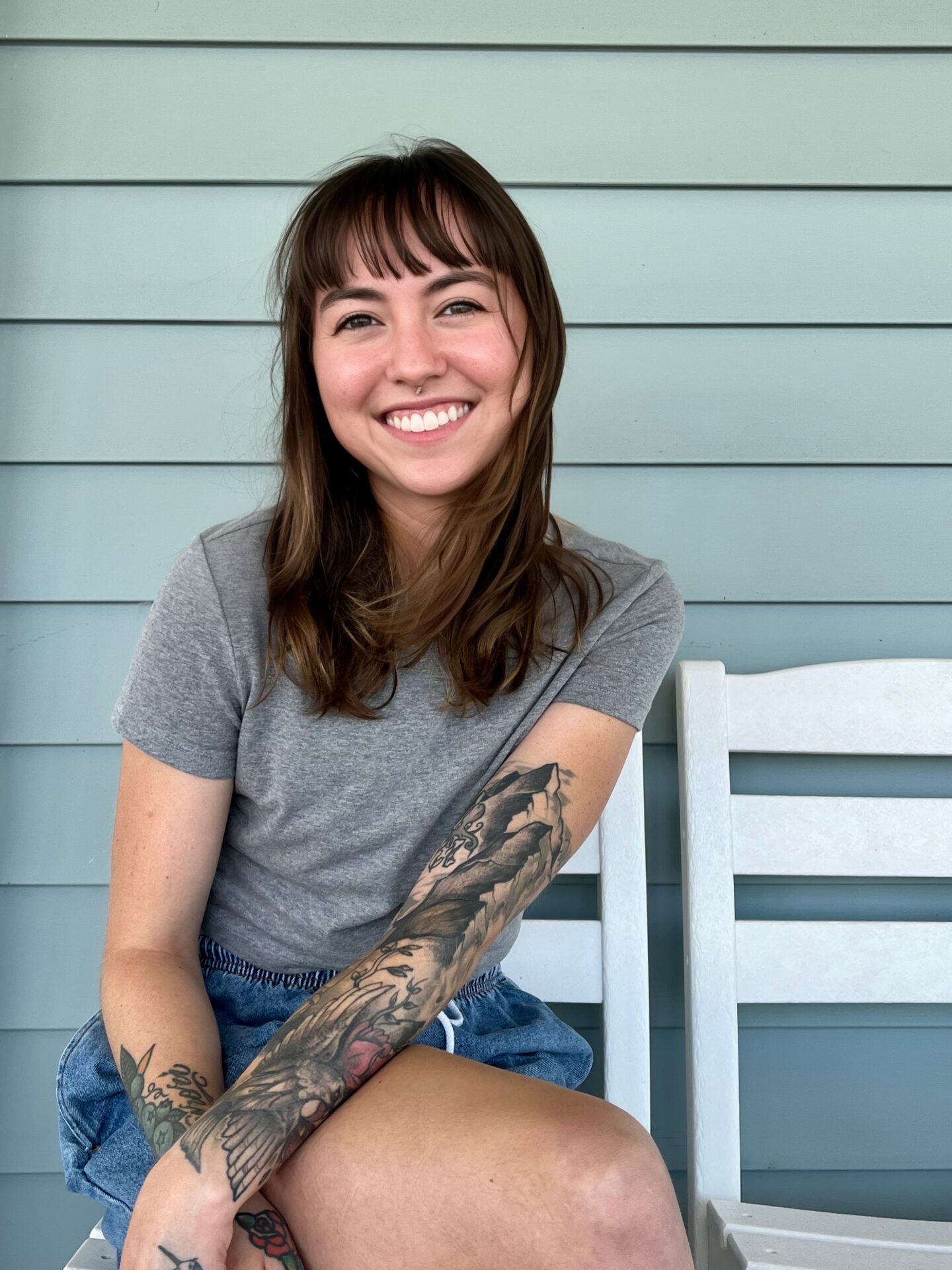
Sydney Kale is a Ph.D. candidate in Wisdom Studies at Ubiquity University, focusing on plant intelligence and phenomenology. Her plant-relationship practice culminates in an exploration of co-authorship with plants in both academic and creative works. While her primary focus is on plant studies, these inquiries provide a lens through which to explore plantness, humanness, and aliveness through deep listening, attunement, and embodied knowing. She is the author of The Love Language of Plants, Becoming Written, and I, Garden, // Garden as Palimpsest. She lives in the Appalachian Mountains of Asheville, North Carolina, where she also publishes a blog and bi-monthly zines sharing her curiosities about the felt experiences of being human and plant.
Return to top
