I remember going out at night and looking up at the stars and wanting them to see us. Not to save us. Please see us, to see what happens to a planet when we haven’t learned how to love each other… That we could become an object lesson for the universe.
— Joanna Macy August 28, 2020[1]
Eco-philosopher, activist, Buddhist practitioner, scholar of systems theory, religion and deep ecology, Joanna Macy traveled the world, teaching how to stay intimately present to the social and ecological challenges of our times. This summer she passed on to the ancestors, dissolved into the universe she loved, leaving a legacy of teachings that speak so directly to the issue of intimacy.
Joanna Macy relentlessly embraced life, pursuing truth as she saw it. She taught how to fully open our hearts in these perilous times. In the late 1980s when I heard Macy speak about how Buddhism and systems theory informed her activist practice, describing her time in Shri Lanka learning from Sarvodaya, a Buddhist-inspired movement promoting communal projects to improve community well-being, as well as her on-going efforts to promote nuclear guardianship, I knew that I had to learn more. Her words, writing, and the opportunities I’ve had to participate in groups engaging with some of the many practices she offered have profoundly influenced my ways of thinking and being in the world. When I happened upon her memoir, Widening Circles, in a used bookstore, I couldn’t put it down. Years later I was touched by the power of her words when sharing portions of her last book Active Hope: How to Face the Mess We’re in without Going Crazy, in a group study Lise Weil and I facilitated for students at Goddard College.
Throughout her work, Macy offers “three stories of our time” as differing lenses through which to understand the present moment. She notes that for those with power and privilege living in the midst of consumer goods and technological wonders, it’s easy to think that the first story, “business as usual”—as “just the way things are”[2] even if it alienates us from each other and the natural world in which we live while ignoring human suffering and ecological destruction. The second story, “the great unraveling,” which names the complexity of social, political, and ecological systems while describing their undoing, offers a starkly different view of current realities, recognizing that conditions experienced by the next generation may be worse than for those living today. Thirdly, Macy envisions the great turning, a transition from an untenable economy based on perpetual growth, to “a life-sustaining society,” committed to living in a way that honors the interconnections of all beings. [3]
Well over a decade ago, when I recognized the incredible numbers of distressed trees near my home in San Diego, trees dying from urbanization, globalization in the form of introduced species, and climate change in all its guises—drought, bark beetles, fire—I pledged to walk with them regularly, following the same paths and bearing witness. Macy’s three stories named the dissonance I felt between the complacent continuation of life as usual and the stark loss I felt when well over half the conifers in San Diego County were destroyed in two huge conflagrations, followed by an on-going massive die off-of oaks from the Goldspotted oak borer (GSOB) introduced from Arizona. How could it be that except in the immediate aftermath of huge fires, these tremendous losses were rarely mentioned in the media? How could it be that there was almost no public outcry or public expression of grief?
I have been deeply touched by Macy’s frank acknowledgement of the great unraveling and the need to grieve this disintegration of complex ecological systems that evolved over millennia. Martin Prechtel writes that “Grief is praise because it is the natural way love honors what it misses.”[4] Macy’s embrace of grief provides an important step towards learning how to love and restoring the relationships that will bring about the great turning.
At the heart of Macy’s teaching is what she describes as the work, or spiral, that reconnects. These practices, developed over decades, provide pathways towards the great turning by rekindling intimate relationships with the worlds in which we live. The spiral, consisting of four steps– gratitude, honoring our pain for the world, seeing with new eyes, and going forth–has provided essential guidance about how to develop relationships with the dead and dying trees with whom I walked.
Diagrams of the work that reconnects depict the first step, “coming from gratitude,” as the roots of the spiral. Even an unraveling world is pulsating with life, such as the cliff roses that spring up from the decomposing limbs of oaks. Instead of just barreling down a trail, beginning a walk with offerings to the four directions as well as the earth below and sky above places me in the infinite web of interrelated beings including the ancestors and spirits, all of whom contribute to the well-being of the live web. Offering, praising the magnificence of the living world is humbling and heart- opening. It initiates a journey from a ground of intimacy, of loving relationships.
As Prechtel observes, feeling love and gratitude for beings in the world in which we live leads to the next step in the spiral, “honoring our pain for the world.” Yet in much of the contemporary world, there is little place for public expressions of grief. Macy notes:
Each day we lose valuable parts of our biosphere as species become extinct and ecosystems destroyed—yet where is their funeral service?… Honoring our pain for the world is a way of valuing our awareness, first, that we noticed and second, that we care.[5]
Ignoring grief isolates us both from natural world and each other. From when I first began walking with trees, I felt that it was essential to create public places to mourn. If we can’t experience the grief and vulnerability of loss, how will behaviors change? Macy explains this succinctly in terms of systems theory; acknowledging feedback, i.e. recognizing that beings are suffering, allows for course correction, whereas turning away does not.
Macy is emphatic that alarm, grief, outrage and more are healthy responses “to a world in trauma.”[6] It is not grief, but the fear of difficult emotions that leads to isolation, paralysis, or debilitating depression.
We can be caught between two fears – the fear of what will happen if we as a society, continue the way we’re going and the fear of acknowledging how bad things are because of the despair that doing so brings up.[7]
Informed by Buddhist teachings on compassion, Macy provides guidance as to how to turn toward despair and suffering, to be touched by pain, to face fear, to suffer with the world and be strengthened by it. One of her books, aptly titled Coming Back to Life, provides a manual for working past the numbing of heart and mind.[8]
Macy’s despair work initially developed in relationship to caring for nuclear wastes. She had a vision of creating Guardian Sites at nuclear facilities, “sites of pilgrimage and reflection.”[9] Instead of burying the radioactive wastes deep in the earth and wishing they would disappear, Macy imagined disposal sites as sites of intimate reflection, places where people could come and be trained, informed by wisdom traditions of world in how to pass on the memories of the origins of radioactive wastes and the constant vigilance that must be maintained from one generation to the next to assure containment. To pursue this vision, she created a Fire Group of a dozen friends that committed to educating each other and teaching the public.
While the group disbanded after six years, each member continued the work in their own way. Macy joined with her husband Fran to offer workshops throughout areas in eastern Europe impacted by the radioactive fallout of Chernobyl. One experience at Naropa University, which houses the Joanna Macy Center of Resilience and Regeneration devoted to her work, stands out in my mind. It was March 2022, shortly after the invasion of Ukraine. Macy had made a short video that we listened to before performing the Elm Dance, a circle dance where everyone holds hands, moves in one direction for four beats, alternating swaying gently for four beats. For years Macy had been offering this dance as an embodied honoring to the elms that have disappeared in much of Europe, as part of her workshops. The dance was passed on to her by two German friends, who created it based on a Latvian poem. Now we too were invited join this circle.
In the recording Macy told of her experience leading despair and empowerment workshops in areas impacted by the Chernobyl disaster. Everywhere she went on that tour, she led the Elm dance, including in her last stop Novozybhov, a town showered by radioactive waste created when the Soviet government, so intent on stopping the spread of radioactive winds headed toward Moscow, seeded the clouds, creating massive storms over Novozybhov. Initially no one wanted to talk of their suffering, of the prevalence of cancers and poisoning of forests which they would not be able to enter during their lifetimes. On the third day of the workshop, she suggested turning to their ancestors for guidance. The structure of the activity, moving from one generation to the next, called in their anguish. The dam broke and the participants had to face their pain. They were furious at Macy. Not knowing how to respond, she told of her experiences in Germany in the aftermath of the brutal world war.
The German people determined that they would do anything to spare their children the suffering they had known. They worked hard to provide them a safe, rich life. They created an economic miracle. They gave their children everything – except for one thing. They did not give them their broken hearts. And their children have never forgiven them.[10]
Macy was afraid the participants would not return the next day, but they did. They shared how hard it had been to speak of the pain and anger but also acknowledged relief; for some it was the first time since the disaster they felt clean. When it was Macy’s turn to speak, she promised that she would not let the world forget, but would make sure their story was widely known.
Feeling loss, honoring pain and vulnerability and expressing these feelings in community through dialogue and role-playing, it is impossible to go back to business as usual. Hence the next step in the spiral: “seeing with new eyes,” or in the current version of the work, with “new” or “ancient” eyes in acknowledgment of traditional wisdom that has been lost or forgotten. This step involves not just “seeing” but perceiving fully with all the senses that have been touched so deeply.
These steps of the spiral are not linear but “fractal.”[11] Feeling and insight are intertwined, each one prompting the other. Honoring pain does not happen all at once, nor does awareness. But at some point, a sudden shift may occur. One is forever changed, experiencing what Macy calls a “wider sense of self,”[12] or wider sense of being, a recognition of the inseparability between self and the larger communities and ecosystems of which one is a part.
Macy describes her experience of this shift so vividly in Widening Circles. Panicked on a jam-packed train, after being thrust by the crowd up to the top berth, she tried to retreat by reading a book about Buddhism, but the teachings on the nature of suffering led her gaze back to the crowds below:
Suddenly I was no longer enclosed inside my own body, but I wasn’t outside it either…. Everything out there—each gesticulating, chewing, sleeping form; each crying baby and coughing heap of rags; and the flickering, swaying carriage itself—was as intimately my body as I… My interior was now on the outside, inextricably mixed with the rest of the world, and what I had tried to exclude was now at its core.
Arriving at a Tibetan community where she receives meditation instruction and engages in a week-long retreat, she has further revelations as she tires of watching her mind bounce from one thought to the next:
The morning light brought a wry and empty calm: so this is the mind I had imagined was mine: here it is, just a cultural catch-all…No point in defensing the precious self against the externalities of life if its crazy jumble was already inside me. A tenderness took hold – for myself, for the voices, for my people in this crazy time on Earth. It felt like abundance, embracing both our noble ideals and our daily absurdities, it felt like compassion. [13]
Touching her own tenderness and vulnerability, her heart broke open to those around her.
I am reminded of my experiences with the oaks with whom I frequently walk with in Pine Valley. This resplendent grove of oaks was one of the first places ravaged by GSOB, the beetle brought from Arizona by way of firewood.[14] I have returned to walk and meditate with these oaks for over a decade as dropping leaves revealed a naked body, as twigs and then large branches broke and fall, gradually reducing a tree to a more elemental form until finally the whole being collapsed onto the ground and slowly sank into the earth.
On one occasion last spring, when late rains brought thick growth that blocked trails, I chose not to forge ahead, but to seek shelter from the blazing sun under a young tree that I had never sat with before. Seated close to their trunk, I felt a tremendous force field. Was it all right to sit here? I felt a tepid yes, “it’s fine but don’t expect me to comfort you.” Facing the tree, I suddenly felt the full weight of what was it like to grow up in a charnel ground, with the remains of your elders, parents, grandparents, aunties, and uncles, friends and relations all strewn about, while the rich web of mycelial connections supporting your roots withered below ground. How desolate — standing alone, somehow finding the will to grow, as your elders, as the whole forest around you slowly decomposed into soil.
An ICE helicopter flew by overhead.
“With all your birds in the sky, can’t you see what you are doing? Drill baby drill. From ozone hole to sink-holes in permafrost, how many holes before you take down everyone with you?”
The last step of the spiral that reconnects, “going forth,” is most fully addressed in Macy’s last book, Active Hope, written with Chris Johnstone. Macy chose the title carefully, aware of the Buddhist teachings of getting caught in endless cycles of hope and fear. Instead, Macy conceived of hope in terms of vision—“choosing life,” becoming an active participant in the great turning, and fully embracing the worlds in which we find ourselves.[15]
The first edition of the book ends with an embrace of the uncertain future with curiosity, even excitement, as a “mystery and adventure.”[16] In the second edition of the book the subtitle has been changed to “How to Face the Mess We’re in with Unexpected Resilience and Creative Power,” to emphasize the resourceful, imaginative potential of actively engaging with the challenges of our times.[17]
###
I am still pondering the oak’s question. At the time, all I could offer was to practice with the tree, singing the mantra of White Tara, evoking the power of melody to summon the compassionate, healing energy of the universe. As the sound reverberated, my heart mixed with the hearts of all beings. Form and space intermingled. The tree and I were no longer alone. Song touched all those around us, permeating the fallen logs, just as their presence soaked into our beings. We were all enveloped in profound tenderness, in the poignancy of being alive, connecting with a tradition practiced for more than a millennium, which joins together the singers, the surroundings, the ancestors of the past, and those to come.
I know that if business as usual continues, if people persist in perceiving of our planet in terms of what can be extracted for immediate gain, the future is not bright. The survival of humanity and many other beings is in question. This knowledge strengthens my appreciation for my intimate relationship with oaks, bestowing “unexpected resilience and creative power” as I continue to tell their stories.
When a loved one is dying, you don’t turn away. You stay with them. Your bonds provide strength for both of you. Someday may we look up at the vast brilliance of the stars and thank Joanna Macy for teaching us how to love.
[1] “The Great Turning with Joanna Macy,” In the Making Becoming Human in a Time Between Worlds https://www.youtube.com/watch?v=WkXpgMWD_5I
[2] Joanna Macy and Chris Johnstone, Active Hope: How to Face the Mess We’re in without Going Crazy. New World Library, 2012 p. 15.
[3] Ibid.p. 26, 28-30.
[4] Martín Prechtel, The Smell of Rain on Dust: Grief and Praise (Berkeley: North Atlantic Books, 2015), 31
[5] Ibid.
[6] Ibid. p.67.
[7] Ibid. p. 65.
[8] Joanna Macy and Molly Brown, Coming Back to Life. New Society Publishers, 2014.
[9] Joanna Macy, Widening Circles: A Memoir. New Catalyst Books, 2000, p. 247.
[10] Ibid. p. 268.
[11] Coming Back to Life, p.68.
[12] Active Hope, pp. 85-103.
[13] Widening Circles, p 106.
[14] My practice is similar to “listening to your world” as presented in the Active Hope training in the unit on seeing with new eyes.
[15] Coming Back to Life, Chapter 1, pp. 1-18.
[16] Active Hope, p. 230.
[17] Joanna Macy and Chris Johnstone, Active Hope: How to Face the Mess We’re in With Unexpected Resilience and Creative Power. New World Library, 2022
About the Author
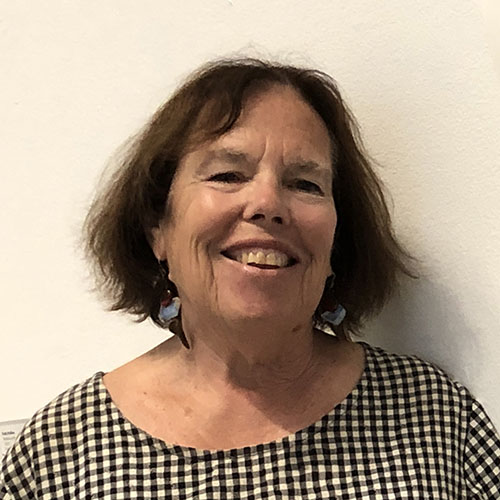
Ruth Wallen’s www.ruthwallen.net art and writing are dedicated to encouraging dialogue around ecological and social justice. Her photomontages, interactive installations, nature walks, web sites, artist books, and performative lectures have been widely exhibited. Recent essays can be found in several anthologies including Communicating A World-in-Crisis, Desert Forest: Life with Joshua Trees, Ecoart in Action: Activities, Case Studies and Provocations for the Classroom and Communities, and Dark Matter: Women Witnessing Dreams Before Extinction. Committed to student-centered learning, she served as chair and core faculty in the MFA in Interdisciplinary Arts Program at Goddard College for many years. Currently she is working on a book about her experiences bearing witness with trees dying from urbanization, globalization, and climate change in all its guises, including drought, bark beetles, and fire.
Return to top
